GMU Math MakerLab

3D Printing of Invariant Manifolds in Dynamical Systems

The following paper appeared: Patrick R. Bishop, Summer Chenoweth, Emmanuel Fleurantin, Alonso Ogueda-Oliva, Evelyn Sander, Julia Seay , 3D Printing of Invariant Manifolds in Dynamical Systems, AMS Notices, 73(1):5-15(2026), doi:10.1090/noti3288, 2026.

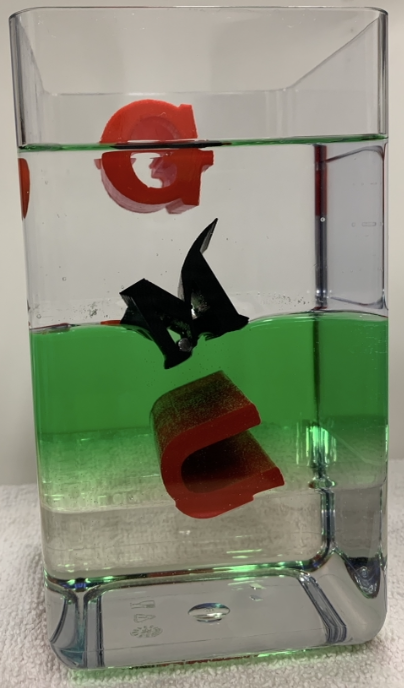
Stability of Floating Objects at a Two-Fluid Interface

GMU Math Makerlab members published a paper:

D.M. Anderson, P.R. Bishop, M. Brant, G. Castaneda Guzman, E. Sander, and G. Thomas, Stability of Floating Objects at a Two-Fluid Interface, European Journal of Physics , 45: 055001, 2024.

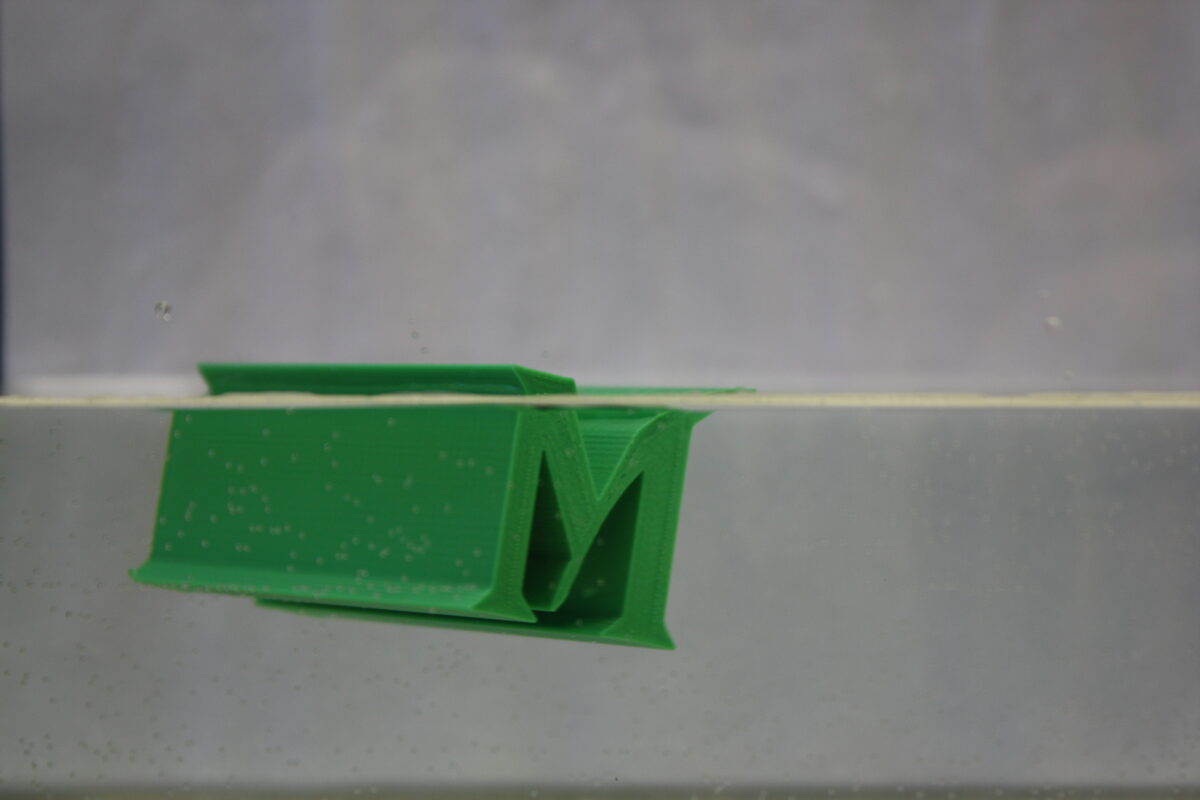
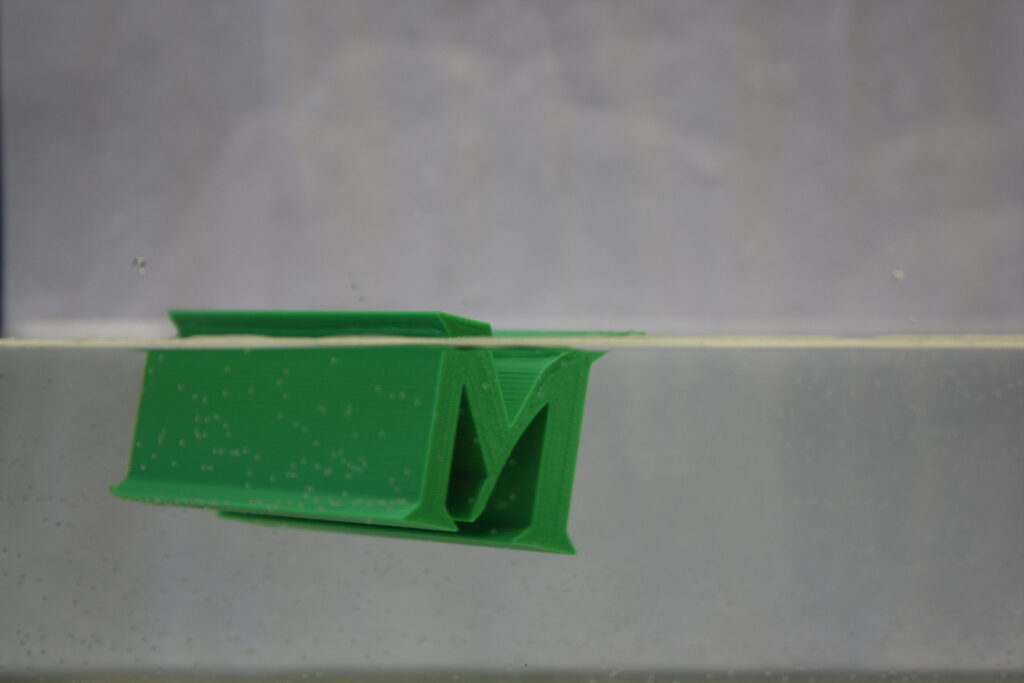
Mathematics of Floating 3D Printed Objects

Members of the GMU Math Makerlab published a paper:

Daniel M. Anderson, Brandon G. Barreto-Rosa, Joshua D. Calvano, Lujain Nsair, and Evelyn Sander (Edited by Maria Trnkova and Andrew Yarmola), Mathematics of Floating 3D Printed Objects , Proceedings of Symposia in Applied Mathematics (PSAPM) , 2023.

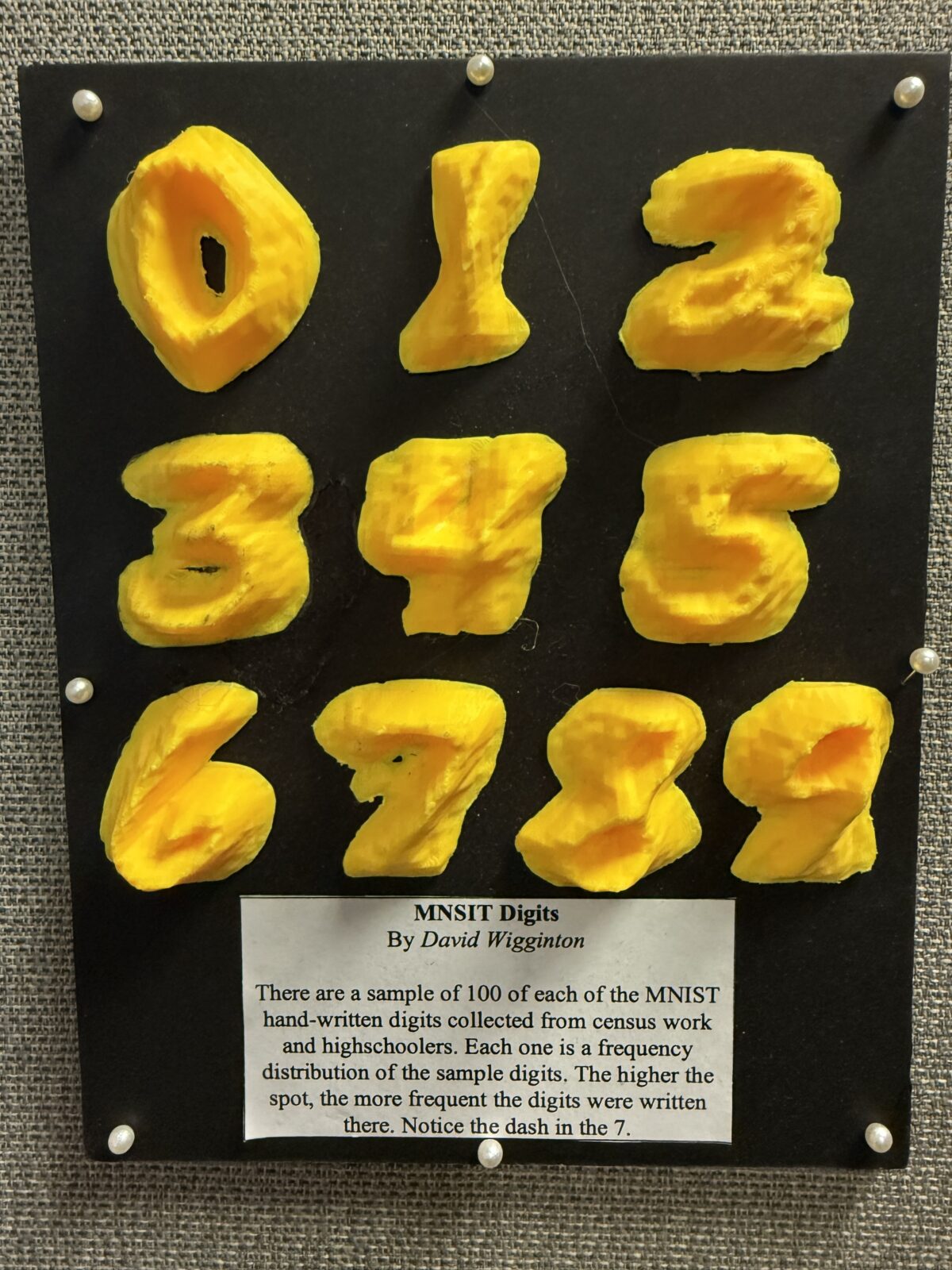
3D Printing Data

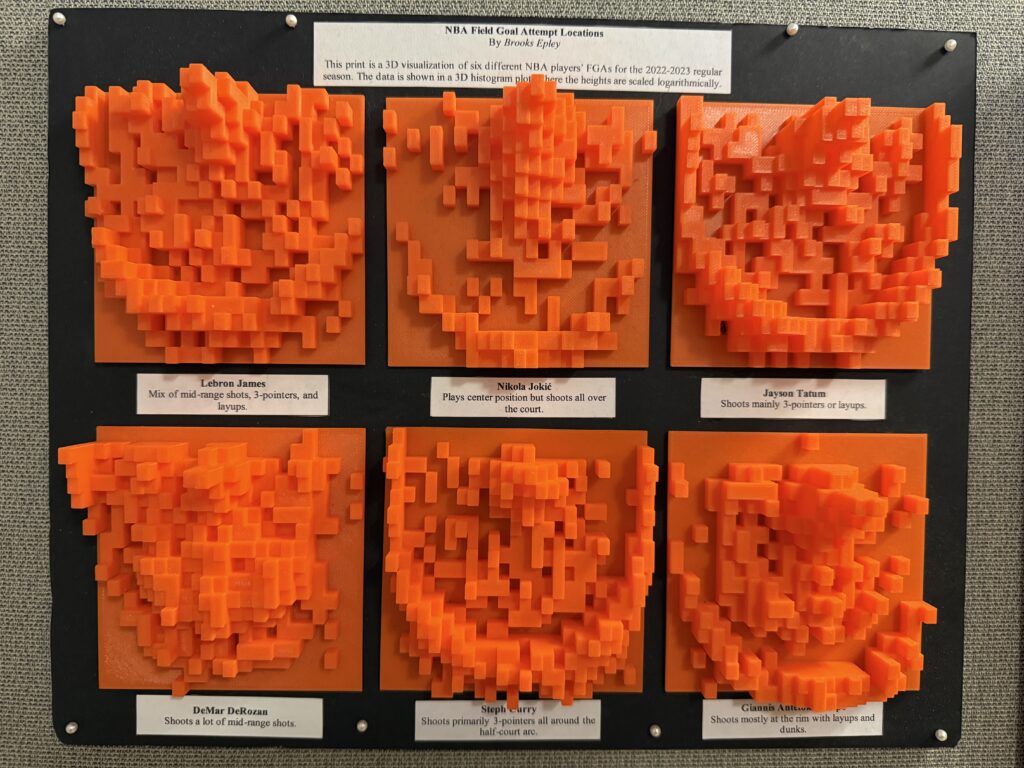
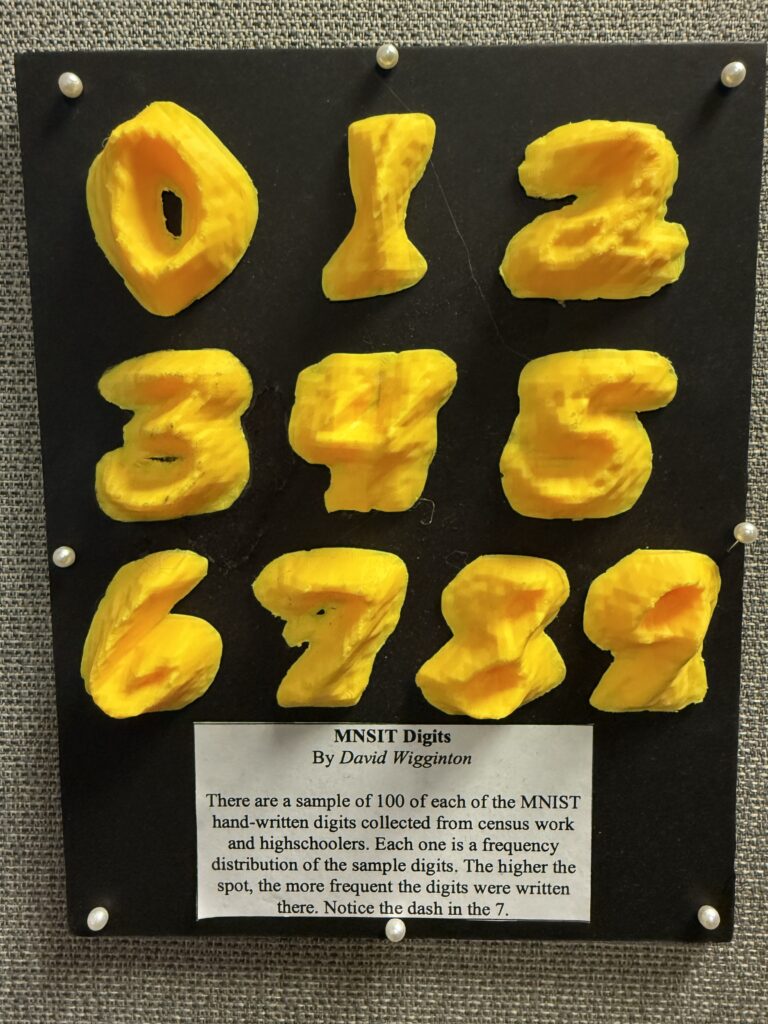
3D printing is a great way to represent data. Here are a couple examples created by students.

Turtles all the way down accepted to math art show

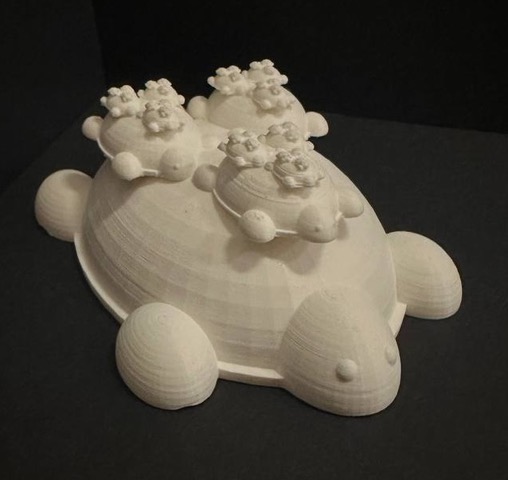
Turtles 3D print

Nicole Savir of the Math Makerlab has had an art piece accepted to the JMM 2026 Mathematical Art Exhibition.

Turtles All The Way Down

by Nicole Savir

The print references an anecdote by mathematician Bertrand Russell, where a woman suggests the world sits on a giant turtle, and when asked what the turtle stands on, she responds: “It’s turtles all the way down!”

The turtles were born from an adaptation of Dr. Sander’s direct recursion code via OpenSCAD. Defining the system f= f1 ∪f2 ∪f3, where for each iterate n, the functions generate 3n turtles uniformly scaled by 1/2n in each dimension and translated by vectors. We define our limiting turtle set as T. T has an uncountable number of turtles and each limiting turtle has infinite turtles underneath.  The fractal dimension of T is determined by covering T with 3n closed boxes of size 1/2n . As n →∞,  the dimension limits to ≈1.585.

Modeling Dynamical Systems for 3D Printing

Stephen K. Lucas, Evelyn Sander (of the GMU Math Makerlab), and Laura Taalman wrote an article about how to practically 3D print actual physical models of such dynamical structures. This appeared in an article in the American Mathematical Society Notices in December 2020 (cover image shown is a 3D printed model from the article). An adapted version appeared in the book The Best Writing on Mathematics 2021, Princeton University Press.

Iterated Function Systems

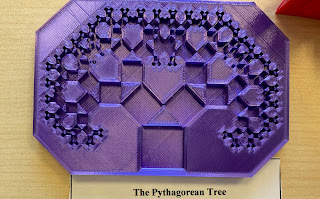
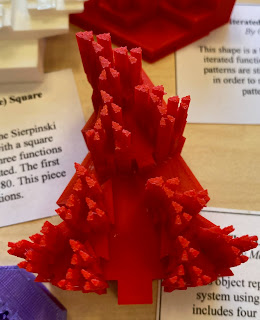
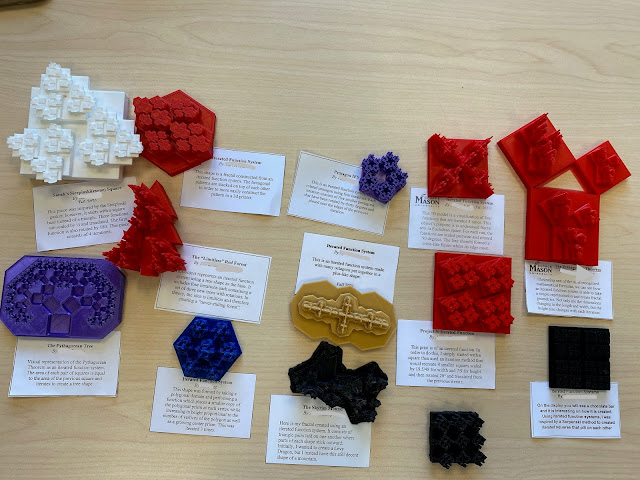
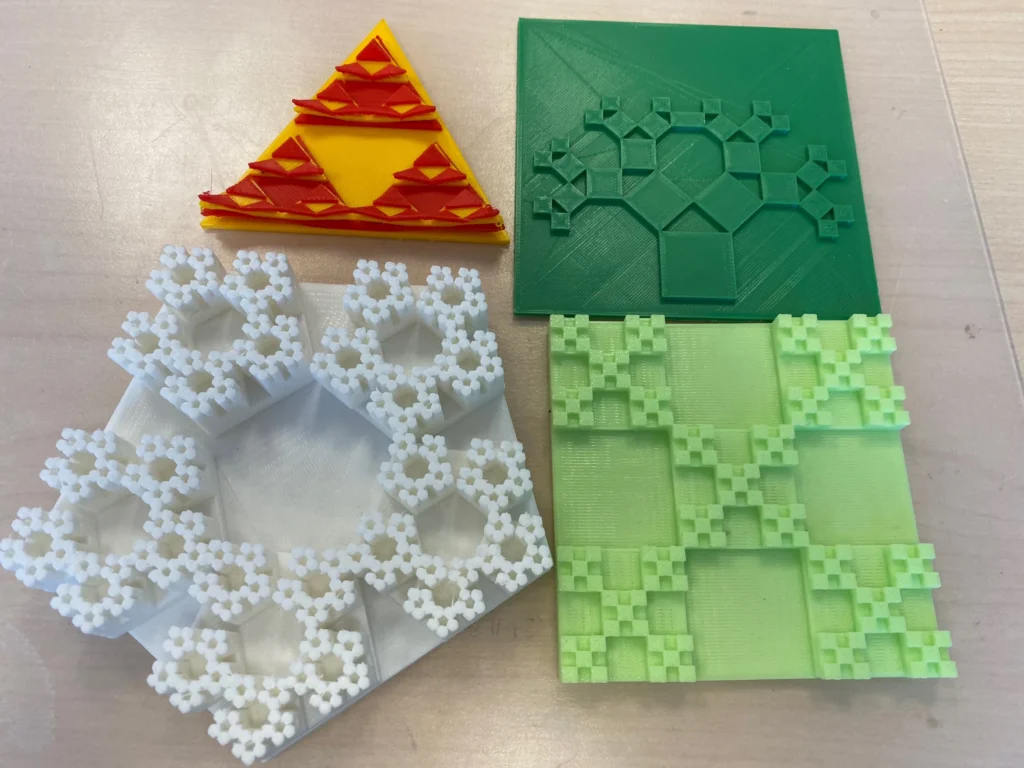
In Fall 2021, GMU Math 401 Mathematics Through 3D Printing created iterated function systems.

Other student-made IFS

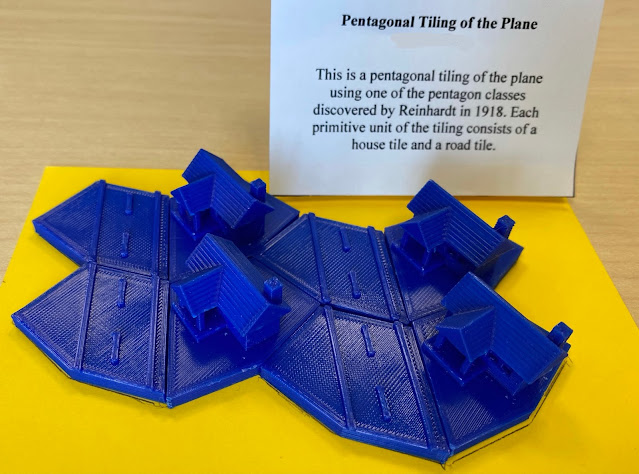
House Street Pentagon Tiling

Fall 2021 GMU Mathematics Through 3D Printing, Pentagon Tiling Assignment: A student’s rendition of one of the Reinhardt 1918 planar pentagon tilings – method for automated suburb creation? OpenSCAD code modified from one by mathgrrl.

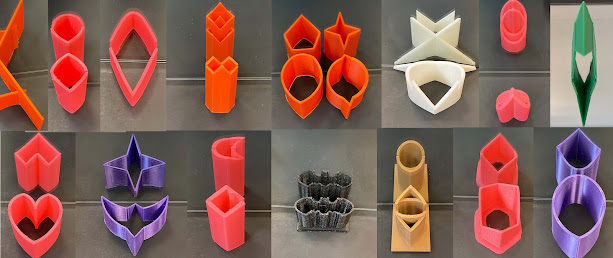
Sugihara Cylinders

In Fall 2021, GMU Math 401, Mathematics Through 3D Printing created mathematical optical illusions. These are objects such that the shape look totally different in the mirror. In each case, you are looking at an object and its mirror image. A diamond becomes a crescent moon, a batman symbol is rightside up both in reality and in the mirror. How does it work? Mathematics! And a clever idea by Sugihara.

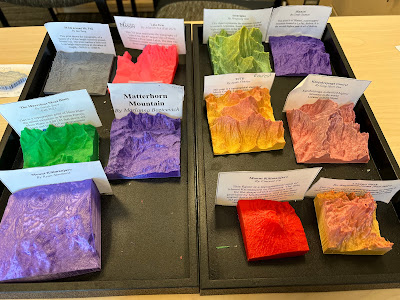
Topographic Maps

In Fall 2021, GMU Math 401 Mathematics Through 3D Printing printed their favorite mountains.